The hybrid era came with a promise to give freedom to employees where they could work from anywhere and anytime. But soon this freedom was introduced with a hidden chaos of overlapping schedules, unclear accountability, and rising stress.
This is where shift and timesheet management tools step in. They do not just organize hours but also provide the backbone that transforms hybrid freedom into sustainable, trusted performance.
When Flexibility Turns into Friction, Clarity Restores Confidence
The basis of Hybrid work is freedom, but freedom without structure takes the form of friction and tensions.
Read More: Why the next 10 years belong to people centric HR?
It is like even though employees may choose when and where they work, managers would still struggle to see who is available, when tasks overlap, or if workloads are balanced or not. This has consequences like stricter settings from managers and stress for employees.
Shift management tools replace disorganized WhatsApp threads and spreadsheets with transparent and automatic scheduling so that employees know their shifts will be clearly defined, while managers know that resource allocation will be fair.
There stays no guess work about who is online or worry about incomplete work as both sides work with clarity. In hybrid setups, that clarity is not just a luxury but a basic foundation of trust and productivity.
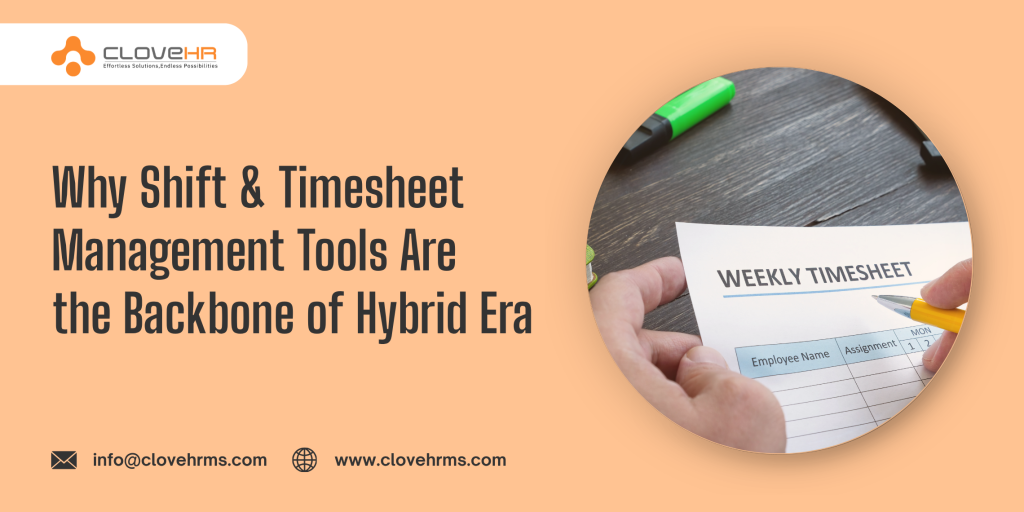
How Timesheets Strengthen Hybrid Teams with fairness and trust?
In the hybrid ecosystem, timesheets do carry the label of micromanagement but in reality, they serve as quite beneficial for employees. With accurate recording hours, they protect staff from being overlooked, underpaid, or stretched too thin.
For all the successful organizations, transparent time tracking stays strongest safeguards against burnout and disengagement. When digitized and integrated into HRMS, timesheets evolve from compliance checklists into trust‑building mechanisms.
Remote employees gain assurance that their contributions will not disappear into the background, while office staff see workloads distributed fairly. In hybrid work, fairness can be traced but timesheets provide the proof every single day.
What do HRMS Tools Deliver to solve hybrid challenges?
Shift and timesheet management tools are not just theoretical concepts but are the everyday backbone that makes hybrid work feel seamless. Their impact is best understood from the visible benefits they bring to both employees and managers so here are these:
- Transparency: Remote and office staff can stay visible to each other systematically so that no one feels left out of the loop.
- Autonomy: Employees can manage shifts and hours freely so that they do not have to rely on constant approvals.
- Trust: Fairness stays in systems without any perception or guesswork.
- Compliance: A few complex parts like Labor laws, overtime rules, and leave policies are automated so that HR teams do not have stress to manage the same.
- Recognition: With accurate records employees get fair pay, bonuses, and acknowledgment of effort.
Being collective, these features change hybrid work from an act of balancing things to actually a structured and reliable system where flexibility and accountability exist.
Seeing Beyond the Screen with Insights and Compliance
Even with clear schedules and fair timesheets, hybrid work can still hide risks that managers do not get to see instantly. A few situations may be that employees may be logging extra hours, workloads may be uneven, or burnout may be taking place silently.
This is where analytics present in shift and timesheet tools become invaluable. They showcase patterns like overtime spikes, productivity dips, or absentee trends which otherwise remain invisible in a hybrid setup.
At the same time, compliance no longer remains a headache because automated systems take care of labour laws, overtime rules, and leave policies without manual intervention. For managers they get foresight and do not have to react late whereas employees feel secure as they know that the system protects their rights.
In hybrid work, numbers do not just measure performance but they tell the deeper story managers cannot see on Zoom calls.
How CloveHRMS Makes Hybrid Effortless?
CloveHR solves the problems of hybrid work with its flawless features like shift scheduling, timesheet tracking, analytics, and compliance automation.
Your employees are free to manage their hours, managers get visibility in real time, and HR teams rest easy because the compliance stays automatic. It is not just software but a backbone that makes hybrid businesses sustainable for the future, keeps everything fair, and makes HR effortless for businesses of every scale.
FAQs
Not just large companies but small teams benefit equally because hybrid schedules cause confusion hence a business running with 10 employees can achieve clarity and fairness.
When you use a good HRMS, timesheets work in the protection of employees instead of controlling them hence your employees get required recognition, fair pay, and prevent burnout.
When everything is transparent, it cuts suspicion so remote staff know their work is visible, and office staff see workloads distributed fairly.
A good platform gives you the room to sync timesheets directly from your existing modules but it is good to consult with the tool provider directly.
Resistance usually comes from fear of control. Position the tools as advocates for fairness and autonomy. Once employees see the benefits, adoption rises quickly.
The tool brings scheduling, timesheets, analytics, and compliance under one roof so that it can support hybrid realities, balance freedom with structure seamlessly.